It looks as if none of our eggs is going to hatch this year, unfortunately.
Eggs fail if they are either not fertilised to start with or they are fertilised, but the embryo fails to develop; the eggs break; the chick dies; or fails to break out of the egg.
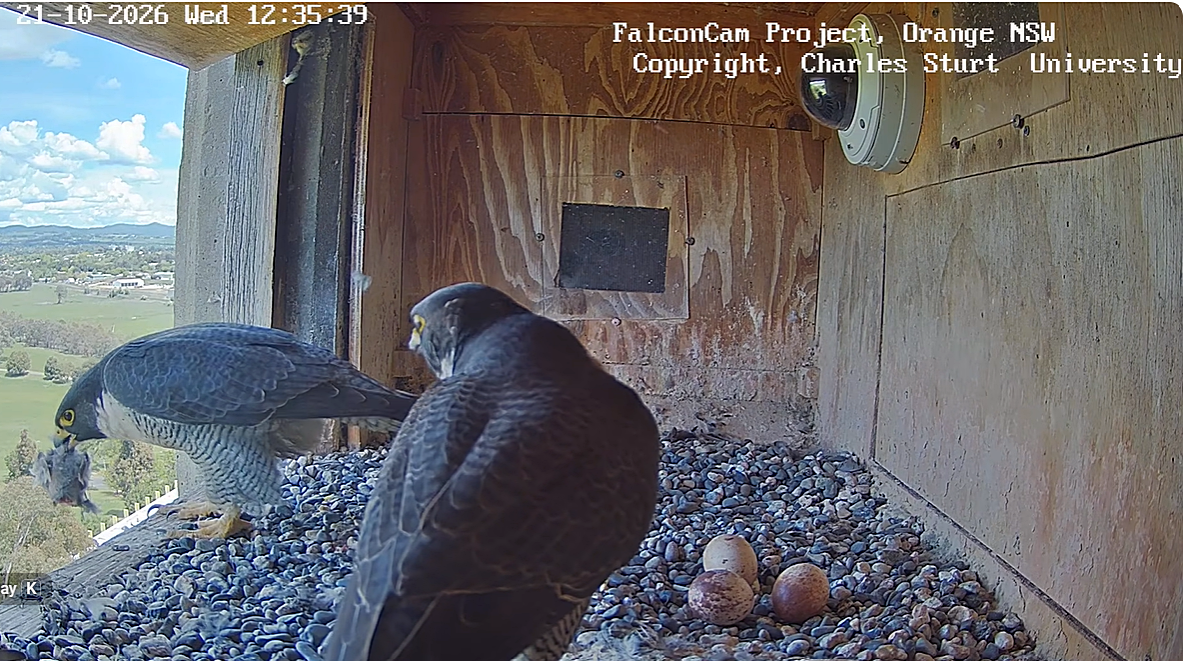
Looking at the first possibility – lack of fertilisation, let’s consider the options. We know that Gimbir (who is now two) is fertile due to the arrival of Girri, our nestling last year, but the actual mating process was a bit sporadic and seemed to finish a bit earlier than usual (they usually keep mating until the appearance of the second egg, but they actually stopped around the time of the first this year). There were quite a few peregrine ‘floaters’ (unattached peregrines) around at that time which might have disrupted the courtship process or caused our pair to be stressed as they had to chase them away.
Alternatively, it is possible that Diamond’s mature age (she is at least 13, but could be considerably older) contributed to the lack of success. Female peregrines can keep reproducing until eighteen or nineteen and the reason you don’t see many older females with young is more to do with the difficulty of holding on to their territory than low fecundity. However, the latter does decline with age.
Regarding the second possibility – that there were fertilised eggs that failed to hatch – well, we know they didn’t break. Nor was the incubation process interrupted, except for very short periods, so the eggs were kept at the correct temperature. And the box provides an excellent protected space for incubation. So there is a chance that the embryo failed to develop for reasons unknown…or was unable to break through the shell if it was too thick or the young were too weak, for example.
After they abandon the attempt to overincubate the eggs (ie cover the non-viable eggs beyond the normal incubation time), I will collect them if unbroken and ‘candle’ them to see whether they were fertilised or not. This process requires holding a torch under the egg so the interior becomes visible. If clear, they have not been fertilised (which I suspect is the case). I’ll do this in the lab in case of breakage, which happened once and I don’t care to repeat the experience.
The adults will probably continue to overincubate the eggs for a week or two, or possibly longer. The reason for this is that when eggs are laid, there is a sharp increase in the hormone ‘prolactin’ in the female’s body and this encourages her to incubate. The level of the hormone drops when triggered by the chirping of the nestlings, but only slowly if they don’t, so the parents don’t actually realise that there is a problem until well after the hatching window has closed.
Having a second clutch is extremely unlikely. They are no longer mating now. If there is any residual sperm in the female’s body it would now be long past its ‘due date’, so no longer viable.
For more information on why eggs fail to hatch, please refer to: https://hawkandowltrust.org/?view=article&id=96:why-peregrine-falcons-lay-eggs-and-why-one-sometimes-fails-to-hatch&catid=10:news